The Workforce Policy Lab (WPL) in NIU’s Center for Governmental Studies was recently selected by the Illinois Department of Commerce and Economic Opportunity to create and oversee the Clean Building Navigator Program (CBN), which will be hosted in six communities across the state. CBN will help residents better access a patchwork of existing energy efficiency and renewable programs, incentives and rebates to lower their energy bills and decrease their carbon footprints.
We spoke with Workforce Policy Lab Director of Clean Energy and Ecosystem Development Christine Flynn to learn more about this program and how it might become a model for clean energy programs in other communities.
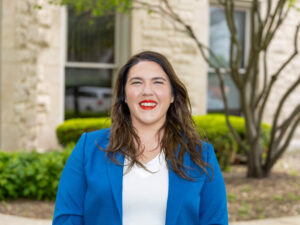
Christine Flynn
Before we get into the conversation, here are Christine’s top tips for communities who would like to address clean energy, climate resilience and energy efficiency:
- Collaboration is key. “We have this massive thing we’re trying to do, which is help all Illinois residents become more energy efficient and use more renewable energy. Right now, we’re all trying to do it individually. But if we coordinate, we can achieve so much more.”
- Choose a dedicated convener for your community. “The level of coordination needed for this to succeed doesn’t take millions of dollars. All it takes is one person or organization in a community who is willing to be a convener and bring everyone together.”
- Start with stakeholder feedback to get the right fit for your community. “We’ve learned that we have to tailor the design of the program to the context to make this work across very different communities. You need to start by determining what challenge is specific to your community that might be stalling the clean energy transition.”
- Get help when possible. “We’re building this aspect of our work at WPL, and we’re available to help if you’re looking for assistance to engage your community on issues of clean energy, climate resilience and energy efficiency. Reach out to us if you’d like to have a conversation about how we can work together!”
**
Keep reading to learn more about the Clean Building Navigator (CBN) Program!
How is the Clean Building Navigator Program funded, and what will WPL be doing?
The CBN Program is funded through a United States Department of Energy grant – the Climate Pollution Reduction Grant (CPRG) – and was awarded to the State of Illinois. CPRG funding flows through the Illinois Environmental Protection Agency to multiple state agencies delivering programs designed to lower greenhouse gas emissions, increase energy efficiency, and promote the clean energy transition of communities across the state.
Part of the CPRG is dedicated to workforce and economic development programs administered by the Illinois Department of Commerce and Economic Opportunity (DCEO). WPL was selected by DCEO to develop and support implementation of the Clean Building Navigator Program in six communities: Alton, Danville, Decatur, Chicago South and West Sides, Rockford and Waukegan
WPL’s work on this program includes conducting research and stakeholder engagement to gather feedback on a draft design that is now being developed into a funding opportunity in partnership with DCEO.
In addition to design, WPL will also act as an administrator conducting technical assistance, developing frameworks for quality control and assurance, overseeing the public engagement and outreach strategies for the program, and taking an active role in developing coordination in these communities to ensure the impact is as significant as possible.
When you say “navigator work,” what does that mean?
Essentially what that means is the community-based organizations will be working with residents of that community to help them “navigate” existing energy efficiency and renewable energy programs and incentives from utilities, the state and/or local municipalities to determine how residents can stack these available supports to lower their energy bills and their greenhouse gas emissions.
This is a way to push forward the clean energy transition by getting more people involved in the programs we already offer throughout the state. Those programs are really significant, but they’re not coordinated and they’re not always known to residents. This is essentially creating a one-stop-shop where a trusted community-based organization will help residents access all the available programs instead of the residents having to go to multiple entities to take advantage of these opportunities
What are some of the programs available that folks might need help accessing?
Essentially, for your house, if you wanted to lower your energy bills, you might go to ComEd and ask, what are the programs you could offer me? They might offer you a rebate if you buy an Energy Star fridge, an incentive if you switch to a smart thermostat or enrollment in an energy efficiency program. In addition to any programs offered by the local energy utility, there are also state programs, and there may be local programs to further the benefit for the resident.
If you come in to speak to a Navigator, they might say, “You’re in ComEd territory. You’re also in NICOR territory. The state has this program that you would be eligible for. Your county also offers a program. We’re going stack all these programs for you and help you lower your energy bills and greenhouse gas emissions, instead of you having to go to each of those entities individually.” That’s the crux of the navigation process.
In addition to the direct navigator work, you mentioned WPL will also take an active role in helping to build coordination on the ground. How will that be done?
That will take place in a couple of ways. Our team will be responsible for building stakeholder networks that the community-based organizations can leverage. We’ll also oversee the work of a facilitator who’s going to coordinate with the stakeholders in each community to come together around a common challenge that is stopping their community from doing the clean energy transition.
That challenge could be, our community has no idea what these programs are, we need to do more awareness work. It could be we don’t have enough people to do the work. There’s interest in it, but we don’t have enough contractors or tradespeople. It could be, the way that our municipality sets up permits or zoning doesn’t align with clean energy. The stakeholders, in collaboration with the facilitator, will start by determining what challenge is specific to each community that might be stalling their clean energy transition.
The communities will work with the facilitator to identify that barrier, and then develop a year-long task force that will push to change or mitigate the identified challenge. That process will happen annually in each community for three years, bringing key stakeholders together to take an active role in addressing challenges and driving the clean energy transition forward.
How has WPL engaged the communities already?
Back in July, we started by sending out a statewide request for information asking stakeholders and professionals in this industry throughout the state, what do they think we should know and do? What best practices should be incorporated? From there, we refined the general outline of the program and then took it to those six communities and did a series of focus groups.
We did two to three focus groups in each community where we presented a draft design and asked, what would work for your community? What wouldn’t work for your community? What do you notice that might stop this from being successful? Everything was on the table. We got feedback about the names of the roles, the timeline, contractor requirements and developing a pipeline to make those requirements accessible, the type of outreach, concerns around trust, how current programs are engaging, marketing, and many other issues. Community members really showed up to these conversations and were willing to share their candid feedback, which was essential to our design.
What we’ve learned from the focus groups is that we have to tailor the design of the program to the context to make this work across six very different communities. We also learned a lot about the different external organizations and systems we’ll have to maneuver through to help our program be successful.
Now that you’ve completed the focus groups and revised the program design, what’s the next step?
At this stage, we’re drafting a notice of funding opportunity for the Department of Commerce and Economic Opportunity (DCEO). DCEO is planning to release that funding opportunity in the next few months, and that’s how they’ll select the entities to deliver this program. The way the design works is there will be two regional leads that will be funded by DCEO, and each of those leads will cover three of the communities. The regional leads will oversee administration of the grant, contracts with the community-based organizations who will meet one-on-one with residents, and they will be mentors to those community-based organizations to ensure they have the support and resources needed to successfully deliver the program.
Once those regional leads are selected, we’ll shift into the role of supporting development, doing continuous improvement and offering technical assistance to the entities that DCEO is funding. As the program gets underway, we’ll continue to have community convenings and focus groups to give us the feedback needed for improvement.
How were those six communities chosen?
As part of the grant that was submitted to the US Department of Energy, Illinois wanted to keep this program within the legislatively selected Climate and Equitable Jobs Act (CEJA) CEJA communities. There are 14 CEJA Capacity Communities in Illinois, but when we looked at the funding and the impact that was desired, we worked with DCEO to identify six communities that we could launch this program in.
We looked at a few different things including the age of the housing stock because anything built in 1985 or before tends to not meet current home building requirements, so there’s a lot of opportunity to lower energy consumption through updating insulation, windows or other energy efficiency measures.
We also looked at the current CEJA ecosystem in each community, specifically the establishment of the CEJA workforce, economic and contractor development programs. Because we only have three years to deliver this work, having existing community connections and relationships can help to move the program forward quickly.
Next, we looked at the difference between the number of people who qualify for a given program in the community, versus how many are making use of it. We determined that we might be able to have a larger impact in communities with larger gaps.
Finally, we looked at geographic distribution to make sure we served communities in different regions of the state. We ended up with – in CEJA categories – two in the northern region, three in the central region and one in the southern region.
Is the goal to grow this to other communities eventually?
Absolutely. We’re treating this as a pilot, essentially, so we can show what we accomplish in these six communities and then use that data to gain funding for a larger program long term.
Is there anything you’ve learned from all your conversations that would be helpful for other communities who would like to do work on their own to become more energy efficient?
What we’re consistently hearing is that no one is doing the work to bring together all the stakeholders within the community, so each program doesn’t know what the others are doing. Each community needs a convener to bring all the local organizations together, whether that’s the municipal government, a nonprofit, a business or even a community college.
The issue that Illinois communities generally face is that we have so many amazing programs, but we don’t have a network of relationships that we can leverage, so everyone is trying to do this piecemeal work.
In my work with DCEO’s Office of Energy and Business Utility, we found an African proverb that talked about, when spiders coordinate, even though they’re each so small, together they can take down a lion. The idea is that if all these spiders are going in different directions, they’re not taking down a lion. But if they all come together, coordinate and strategize, even these tiny spiders can bring down the king of the jungle.
That is really our task here. We have this massive thing we’re trying to do, which is help all Illinois residents become more energy efficient and use more renewable energy. Right now, we’re all trying to do it individually. But if we coordinate, we can achieve so much more.
I want people to know, that level of coordination doesn’t take millions of dollars. All it takes is one person or organization in a community who is willing to be a convener and bring everyone together. Can you be the convener or help to identify a convener in your community? Can you help to identify your community’s collective goals around energy efficiency and renewable energy so everyone can work together for the common good?
