
Candace Dickerson, a program manager for NIU’s Workforce Policy Lab recently presented “Connecting the Dots: Lessons from CEJA Integration” at the Illinois Community College Board Forum for Excellence. These lessons are applicable to anyone who needs to coordinate with multiple agencies to better serve residents.
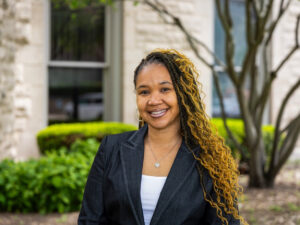
Candace Dickerson
Here are some of the takeaways Candace shared that might be useful to any of us.
What is CEJA?
CEJA stands for the Climate and Equitable Jobs Act, and in Illinois it sets up a series of workforce development programs focused on preparing residents for “clean energy jobs,” which means any job in renewable energy industries, such as solar and wind, energy efficient heating and cooling, battery storage and electric vehicles. These programs serve individuals in targeted geographic areas or communities with higher needs, such as individuals currently or formerly in the foster care system or who were formerly incarcerated.
The CEJA workforce system consists of three main types of organizations:
- Workforce Hubs are regional training sites across Illinois that provide clean-energy job training, a training stipend and wrap-around services such as childcare.
- Climate Works Pre-apprenticeship Programs are foundational programs designed to prepare participants to transition into registered labor and building trade apprenticeships.
- Navigators are the front door to the CEJA system. They recruit individuals, help assess their eligibility, and refer them to either a Workforce Hub or Climate Works program.
Why can community college staff and other community organizations benefit from these lessons?
The challenge with implementing CEJA was integrating many different organizations to better serve the individuals in the program. That includes community organizations, workforce programs, community colleges, employers and adult education providers.
Community colleges routinely coordinate with all these different types of organizations, as do many different types of community-based organizations. Whether you’re working on CEJA or a different workforce or talent pipeline program, it’s important to understand how all the different resources connect.
What are your top lessons for community colleges and community-based organizations who would like to better serve residents?
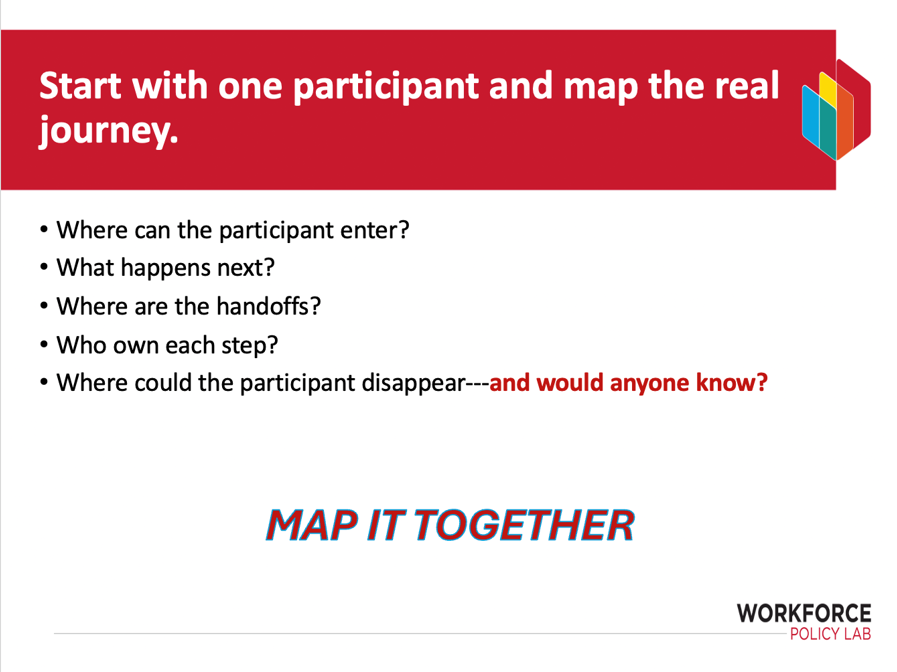
Overall framework: What does the individual participant experience?
One of the most important lessons is that every organization can be doing good work and providing quality services – but a participant who is making use of these services can still be confused, delayed or disconnected when moving from one step to the next. It’s vital to follow individual participants through the system, step-by-step to find and address any systemic barriers that might exist.
Lesson One: A referral may not be a successful hand-off.
One recurring challenge we found was what happened (or didn’t happen) after a referral was made. A staff member might send a participant’s information to the next organization or share an application link with the participant. But did the participant and the staff member at the new organization actually connect? A completed handoff means the next organization received the information, contacted the participant, took action and communicated what happened. This requires follow up to make sure the participant doesn’t fall through the cracks.
Lesson Two: Define who owns the next step.
After the referral happens, which organization follows up? Who does what, and when? General communication or a relationship between two organizations might not be enough. There has to be a shared, systematic understanding of each person’s role in the process.
For example, let’s say a Navigator refers a participant to a Workforce Hub for training. The Navigator may consider the referral complete once it is sent, while the Hub may be waiting for the participant to complete an application or attend orientation. If the participant never completes that step, who notices? Who reaches out? Both organizations may have completed their usual tasks, but without clear ownership, the participant can still disappear between referral and enrollment.
Lesson Three: Barriers need a response protocol too.
A participant may face transportation, childcare, technology, financial, academic or scheduling barriers. Having resources available does not automatically mean the participant can access them when needed.
A coordinated response has clear steps: identify the barrier, connect the participant to a resource, assign someone to act, address the barrier and follow up to see whether the solution worked. If no one owns those steps, a participant may leave even though a resource technically existed.
Lesson Four: Shared language creates shared visibility.
During our CEJA work, we found situations where organizations were not necessarily reporting data incorrectly … but they were using different definitions. One partner might count a participant as “enrolled” at one point, while another waits until a later step. The same issue can happen with terms such as “applied,” “training completion,” “program completion,” “placed” and “retained.”
For each important term, partners should agree on what it means, who records it, when it is recorded and where it is recorded. Sometimes what looks like a data problem is actually a process problem showing up in a spreadsheet!
Connected by design: Moving from “collaboration” to “integration.”
Illinois has many strong programs, committed partners and valuable resources. The opportunity we have now is to connect them more intentionally around the individual participant.
Collaboration is relational. Integration is structural. When we intentionally connect the system behind the scenes, our participants don’t have to. Our goal is to be “connected by design.” That means even though there are many programs, there is one, unified participant journey.
