
The 16th annual Illinois Financial Forecast Forum is coming up on January 8, 2026, at NIU Naperville with an online option. It features experts from the private sector, presenting about their industries to public sector leaders and administrators.
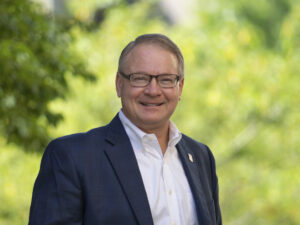
To celebrate this unique event, we spoke with two of the people behind it to learn about its history and why city/county managers and other leaders come back year after year. Keep reading for our interview with Greg Kuhn, Director of NIU’s Center for Governmental Studies, and Dawn Peters, CGS Assistant Director and Team Leader for Association Management.
Registration is open. Register online here!
Can you start out by sharing a bit about the purpose and the history of the Illinois Financial Forecast Forum?
Greg
The origins of this go back to 2008 when the country was in the midst of the financial meltdown and the housing crisis. I had a group of friends in in the neighborhood we’d lived in for 40 years. Everyone else except one person was in the private sector, in pretty high-level positions. We’d sit around once a month, playing cards, and we’d get to talking. The whole nation was on the fiscal edge, and each of these people were sharing what was going on in their industries. We had logistics, residential real estate, commercial real estate, manufacturing, law, technology, marketing, all kinds of fields.
I thought, the people in government circles that I know need to hear this conversation because what these people in the private sector are talking about is from a different perspective and a different conversation than many of the conversations we were having in the public sector at the time. So I came back to my friend and colleague Dawn and asked, what do you think of this idea? Do you think we could get a group of public leaders and administrators together, and would they be interested in hearing this conversation from private sector folks?

Dawn Peters
CGS Assistant Director and Team Leader for Association Management
Dawn
Your thought sparked the whole thing! I was just looking back at my records, and our first attendance was 130 people. That was in January of 2009. So yes, people in the public sector did want to hear these conversations.
Greg
If you remember what it was like back then, those were very uncertain and unsettling times. For students of history and political science, it felt like we might be on the edge of a new Great Depression. Things were swirling and collapsing financially, and the federal government had to step in.
So, we pulled together a panel. We brought in an economist from the Federal Reserve in Chicago to talk about the overall picture of the economy including the collapse, and they showed us charts of GDP, unemployment, industries, etc.. I have to say, I’ve never seen charts like those that turned so negative so fast. I left that first session more depressed than when I walked in. But I also left knowing a lot more than the beginning of the day.
Dawn
You were not alone! Many people walked out of that session saying, it was all bad. There was no good news.
And yet, 16 years later, you’re still planning the Financial Forecast Forum, with larger attendance than ever. What is it that government employees find valuable about the private sector perspective?
Greg
In addition to economists, each year we bring in people from different private sector industries and roles to talk specifically about economic conditions, retail, real estate, healthcare and labor relations. Those are the big topics we address every year, as well as certain specialized topics that come and go. There really is something different about the private sector perspective that’s valuable for public sector folks to hear.
The main difference is that the private sector is good at looking forward as well as backward. They’re in fast changing environments that are faster moving. The public sector is slower, more stable and more predictable, on purpose. Changes take more time to affect the public sector. In the private sector people are dealing with markets that change quickly, so it’s a different and much more dynamic environment.
But, of course, the changes that happen on the private side, the decisions made in the private sector, all eventually end up affecting the public sector, and are especially noticeable at the local government level.
Dawn
When we started this, we called in the Future Forecast Forum for a very intentional purpose. We don’t want our presenters to just look back at the history of markets. We wanted them to look at the present and the future to help provide our public sector leaders the information they need to better plan for the future and create more accurate budgets.
Knowing, what’s happening now in retail, and what will be happening in the near future, is helpful because sales taxes are a huge part of local government budgets. Back in 2008, in addition to the housing crisis, there were also huge changes happening to retail markets with the increase of internet shopping. That changed everything when it came to local retail.
In a similar vein, knowing about the present and future of residential and commercial real estate is important because property taxes are a large part of local budgets. It’s also important when it comes to strategic and land use planning. All of a sudden, there were so many empty strip malls, and traditional malls were going bankrupt. Local governments had to think about – how can we move forward? What can we do with these empty buildings, and how can we make changes in the face of the retail crisis?
Greg
Yes – there are so many examples, but another one that sticks with me is warehousing. Years ago, there was a respected land use specialist out of Virginia (at the time) who said that something like 40% of the built environment we’re going to use in 30 years doesn’t even exist now. At first I thought, that sounds crazy! But fast forward to today, and our built environment is full of warehouses, distribution hubs, offices and data centers that didn’t exist, say, 16 years ago when we began the Financial Forecast Forum. I don’t think that prediction was that far off.
Who is the main audience for the Forum, and how do they benefit?
Dawn
We have city managers, county managers, administrators and city finance directors. We also have planners and finance officers because we partner with APA (the American Planning Association) and the Illinois chapter of IGFOA (Illinois Government Finance Officers Association). We also have some elected official and community development directors. The information is useful to all these folks, and by attending they can get continuing education credits needed to maintain their credentials.
Greg
Who attends has also expanded geographically because we’ve added an online component. During COVID we switched to online – because these private sector perspectives were as important as ever, and we needed to be able to still meet – so we went virtual. Now that we’re back in person the past couple of years, we’ve kept the virtual option. You could say we’ve gone hybrid, with an online option that broadens our reach and can add convenience for those not able to easily travel. Especially with the weather being so unpredictable in northern Illinois in January, people can attend online if the drive is too long or the weather too bad.
Dawn
We get the majority of attendees at NIU Naperville in person, but out of about 280 attendees last year, about 100 of them attended online. The NIU Naperville staff assist us with all the technology to make the online conference a good experience, and it helps us to extend our reach across the state. In fact, I always remind our speakers to provide a balanced perspective of the whole state, not just the Chicago metro region.
Did you ever think, when you first started the Financial Forecast Forum, that it would be going strong 16 years later?
Dawn
Not really, but it’s become an annual event, and many people say it’s a highlight that they look forward to every year. We have a lot of repeat customers!
**
Here are some event details. Don’t forget to register!
Illinois Financial Forecast Forum: Private Sector Views That Will Impact the Public Sector
NIU Naperville Regional Center, Naperville, IL and online via Zoom
Thursday, Jan. 8, 2026
8 a.m. – 3:15 p.m.
Economic and Industry Perspectives
Dr. Kristen Broady, Senior Economist and Economic Advisor and Director of the Economic Mobility Project, Federal Reserve Bank of Chicago
Future Trends in Healthcare
Bobby Dufkis, Senior Vice President, Horton, A Marsh & McClennan Agency LLC
Future Trends in Employment/Labor Relations
Ben Gehrt, Partner, Clark Baird Smith
Dynamic Trends in the Current and Future Retail Environment
Elliot Cook, Director of Real Estate, Retail Strategies
Real Estate Perspectives: The Future of Housing, Commercial and Industrial Real Estate
Geoffrey Dickinson, AICP, Partner, SB Friedman
Elena Caminer, Senior Project Manager, SB Friedman
