
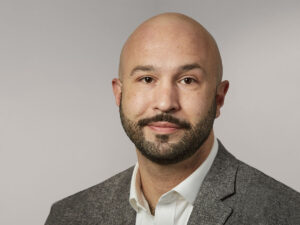
Alexios Rosario-Moore, Ph.D., is a Community Engagement Research Fellow in the Division of Outreach, Engagement and Regional Development and a Visiting Assistant Professor in the NIU College of Education. Alexios is studying the prevalence of and institutional support for community-engaged research, teaching and artistry at NIU. We spoke to him to learn a bit more about his background and how he got interested in this topic.
Can you share a little bit about your background and how you got interested in education and community engagement?
I started out as a youth worker and a teacher at El Puente Academy for Peace and Justice in Brooklyn, which was a charter school started by a local nonprofit organization. A lot of our pedagogy was being engaged in community issues. I became the academic director of the Brooklyn Center for the Urban Environment, where we did a lot of urban environmental-based projects with youth and some policy advocacy. Then, I moved to New Orleans, and I was the academic director of Bard Early College and worked on developing early college pipeline programs as a partnership between the community college and Bard College. When I moved to Chicago, I was a policy director for Generation All, which was an organization advocating for community high schools. As a fellow with Chicago United for Equity, I was also the principal designer of the Vote Equity project.
My work included being involved in a lot of community-based projects from many different perspectives – being a member of the community, part of a nonprofit or part of a university. I think that helped me develop an understanding of the multiple perspectives of community engagement.
Can you say a bit about how your experiences influence your research?
Even as a young person, I was part of policy initiatives that I didn’t realize I was part of. I think that, along with my work with youth, influenced my interest in educational research and community engagement. I went to the Boston public schools, and at the time I didn’t realize that the gifted and talented program I was part of was actually an attempt to diversify and desegregate schools after busing was found to be unconstitutional.
It’s always interesting to look back at the arc of your life and see the different positions you’ve been in. I think having that experience helps me understand that it’s important to inform community members about research and policy, and for people to have agency, to understand what their role is, and be given more prominent roles as co-researchers.
More recently, I’ve conducted research and written some more theoretical papers around the relationship between universities and communities, and they’ve grown out of that understanding of community engagement. Especially when you’re dealing with the social world, I believe that the knowledge you produce is more likely to be more accurate and valid when you learn from community knowledge and engage community members as co-researchers.
What’s your role at NIU this year and in the coming years?
I’m a visiting assistant professor in the College of Education in the Department of Educational Psychology, Foundations and Leadership. My primary responsibility is teaching research courses in the education doctoral program and advising doctoral students. I’ll be starting a tenure track position as an assistant professor in that department in the fall, and I’m really excited about that opportunity.
I’m also a Community Engagement Research Fellow in the Division of Outreach, Engagement and Regional Development, which is why I’ve had the opportunity to work on a longitudinal research project to study the institutionalization of community-engaged teaching, research and artistry at NIU.
