
This year, DeKalb County Court Services is partnering with an NIU Community-engaged Course, Gender and Crime (Criminology 487/Sociology 587) taught by Sociology Professor Carol Walther. The students will analyze pretrial and probation data, with a particular focus on revalidating the pretrial risk assessment the county uses to help judges make data-driven decisions about when an individual can safely be released pending trial.
This is the latest in a decades-long partnership that has helped to make DeKalb County a model for pretrial best practices, as well as for rehabilitation-focused community corrections that reduce recidivism, reconnect offenders with their jobs and families, and keep communities safer.
Keep reading for an interview with Michael Venditti, Director of Court Services for DeKalb County. (Mike is also an NIU alumnus who earned his degree in psychology!)
Can you start off by sharing a little bit about what you’re planning to do in partnership with Professor Walther’s course this semester?

We’re looking to partner with Carol and her class to utilize the data we’ve pulled from our data management system. We have a very elaborate data management system that allows us to pull out and correlate an almost infinite number of data variables, which is fantastic for analysis purposes. In particular, we’re looking to revalidate the pretrial risk assessment we use. We’re also interested in getting an analysis of our probation recidivism data.
Within the field of probation, pretrial, treatment court and community corrections, there has been for several decades now an enormous push for evidence-based practices. We know now that treatment court and other rehabilitation-focused models can be effective to reduce recidivism and drive behavioral changes, but it’s hard to track incremental improvements without robust data. A sociological approach provides the methodology needed to accurately understand and use this data.
Can you say more about the pretrial risk assessment tool the county uses?
Yes! Within the pretrial department, we utilize a tool that’s called the Virginia Pretrial Risk Assessment Instrument. Ultimately, the tool is using primarily static factors that we know immediately upon arrest of a new individual prior to going up in front of the judge for first appearance. The tool helps us determine the probability or likelihood of them fleeing the jurisdiction or picking up a new criminal offense, and we’re particularly concerned about the likelihood of a violent offense.
Years ago, we contracted with NIU for Carol and her now retired colleague Jack King to do a small validation study on our pretrial risk assessment. We’ve been using the tool since early 2016, so it’s time now to do a revalidation study to make sure the tool is working effectively right here in DeKalb. So this semester, we’re asking Carol and her students to look at the data from the past almost ten years and find out – how accurately was the tool able to predict which defendants had issues in the pretrial period? How accurately did the tool predict success versus failure for those individuals, right here in DeKalb County?
Can you say more about why this tool is important, and how the data helps to keep the community safer?
The tool gives the judge a better way of making a very quick determination as far as who can safely be released in the community and who cannot. Illinois is the only state in the country that has completely eliminated the use of cash bail, so the judge has to make a decision to either keep this person in jail or let them out. Ultimately, an important piece of the judge’s decision-making process is using an objective tool that lets them know what’s the probability that this individual will be a danger to the community.
Why has it been helpful to you to partner with NIU?
Having NIU in our backyard has been a blessing to our department for far longer than I’ve been here. The gold standard always is to get an independent third-party researcher that that can do this data analysis work for you, so you eliminate potential bias.
Because of the data analysis Carol and Jack have done for us, our pretrial program is nationally accredited by the National Association of Pretrial Service Agencies (NAPSA). We are the only pretrial department in the entire Midwest to have achieved that level of recognition, and one of only four or five in the country. It’s a very intensive process to get accredited, so this accreditation is something we’re very proud of.
How else is the data helpful in your daily work?
As Carol can attest, I’m what I like to refer to as a data research enthusiast! I’m very quantitative and I love research, especially anything that could lead to application within the field. As I’m doing the work each day, I’m constantly thinking, how can we measure this, how can we refine it? How can we make this more efficient and more meaningful?
For example, just the other day we had a meeting with the new State’s Attorney, and I was able to sit down and present – here’s the research, here are the numbers we’re seeing, and here is why we’ve made the decisions we have. When you have good data, it becomes very easy to have those frank conversations with stakeholders and to build meaningful relationships because they understand that we’re not just pulling ideas out of a hat.
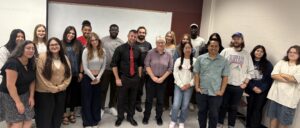
Michael Venditti and Professor Carol Walther (center) with Gender and Crime students
What are some of the types of variables you look at from the data, and why are they important?
In the earlier study we did with Carol, the number of variables we looked at was fairly narrow. Moving forward we’re hoping to look at a wider range of variables. We’ve got all the demographics tied to the individual as well as data about the specific types of offenses, history of offenses, history of court appearances or failure to appear, as well as conditions of release. We’re excited to be able to analyze the data for any trends and correlations, especially any that we didn’t anticipate.
In the earlier study, one outcome that was significant was that people with self-identified mental health or substance abuse issues were inherently more likely to have failure to appear in court because that’s a barrier to being able to manage a schedule or transportation to get back to court. Carol brought that finding to us, and it started a conversation about more mental health resources to address the problem.
Another big take away from that study was, when we evaluated all the data we had at that time, it definitively said that in DeKalb County race, gender and ethnicity had no impact on how the system interacts with people. We’re very happy about that because ensuring equity for all residents is a priority for the department.
For those of us new to this topic, can you explain what community corrections is and some of the approaches to it?
Community corrections includes probation, parole, community service or drug treatment – any kind of court-ordered correctional intervention that takes place outside the jail or prison setting.
There have been two main approaches to community corrections since the 1960s, and the pendulum has swung back and forth between the two. One side is the monitor and report approach, which assumes little to no rehabilitation is possible, so probation officers are primarily responsible for monitoring individuals to put them back in front of a judge or back in jail as soon as they make a mistake.
The other side is focused on rehabilitation and eliciting behavioral changes to restore individuals to functional members of community who are living crime free lives. Especially with the ability to gather detailed data, we’re seeing that some interventions really do work, such as cognitive behavioral approaches, but they require a grounding in sociology and psychology and an effective risk assessment to see what interventions each individual is likely to need. We often partner with outside agencies and our NIU extern for those interventions.
Interesting! What’s an extern, and what do they do?
What we call our “externship” is basically an internship with a doctoral level student. We’ve had a long-standing agreement with the NIU Psychology Department to have a doctoral student under direct supervision by an NIU faculty member here on site to conduct psychological evaluations and testing for us. They also run in-house anger management groups.
For years, we used to have ongoing issues trying to get psychological testing evaluations. There’s a limited number of agencies with the expertise to conduct the specific type of testing we needed, to test for IQ, developmental disabilities, psychiatric issues, antisocial personality traits, and so on. We need to understand all these things to effectively refer an individual to services or to determine the need for ongoing intensive supervision.
Before the partnership began, our department went to an outside diagnostic center to get psychological evaluations, and the wait list was in excess of 9 to 12 months. That became a significant enough barrier that my predecessor reached out to the NIU Psychology Department to set up that partnership about 15 years ago, and we’ve had an absolutely wonderful experience with this.
What are some of the community benefits of your NIU partnerships?
The work we’re doing with individuals directly contributes to community safety. That’s the bottom line and our main mission here. The data-driven decisions that we’re making in the pre-trial world impact community safety every single day by ensuring that judges have objective data to determine who is dangerous to the community and who is not.
There have also been countless times the psychological testing has had a direct impact on a case-by-case basis. Here’s just one example: through the evaluations we were able to determine that one individual had developmental disabilities that they had made it into adulthood without being aware of. That knowledge allowed us to make a massive transition in how we’re interacting with that person and what resources we’re putting in place. They went from being somebody who was absolutely going to prison for the umpteenth time to being somebody who instead successfully completed probation and is doing very well.
If you can determine that someone is not a danger and they can continue working, being part of their family and community while in pretrial, why is that a benefit?
There’s a direct benefit to that person, certainly, but there’s also a surprising benefit to the community as a whole. Research done by Dr. Marie VonNostram, an expert in pretrial justice, found that – when all other factors are equal – pretrial incarceration has a very clear negative effect. Those individuals who were able to secure release within three days of initial incarceration are four times less likely to pick up another felony charge within the next two years, as opposed to those who remain incarcerated for 72 hours or longer.
Nobody expected that result, but once you think about it, it makes sense. When a person is arrested, they’re pulled out of their livelihood, family and support system. They lose income and maybe lose their job. By the time the person is finally out of jail, they’re that much more horrifically desperate than before. That’s why being able to meaningfully identify those people that are appropriate for release and get them out soon is so critical. It means that person is much more likely to be a productive member of society at some point down the road instead of a constant community risk.
