
 An interview with CGS staff members Mim Evans, Paula Freeze and Rachel Gorsuch Sorensen.
The NIU Center for Governmental Studies recently completed a project with the City of Woodstock, which resulted in the city’s new Cultural Arts Master Plan. We sat down with CGS Senior Research Associate Miriam “Mim” Evans, Research Specialist Paula Freeze and Graduate Assistant Rachel Gorsuch Sorensen to learn more about the project and the team’s working process. This may have been CGS’s first arts and culture master plan, but hopefully it will not be the last!
**
I know you’ve worked with the City of Woodstock on several projects. Can you start out by sharing a bit about that relationship and how it’s developed over time?
Mim
Paula and I were both part of the team the first time we worked with Woodstock, for the courthouse project in 2018. The courthouse building was no longer in use as a courthouse, but it’s a wonderful historic structure on their downtown square. The city reached out to us for ideas on how to reuse that building, so we did a study and presented some suggestions. The building now houses a number of businesses and event spaces and is an anchor in the town.
A few years later, Woodstock approached us to work on their Age-Friendly Livable Community Action Plan, which ended up winning an award from the American Planning Association-Illinois Chapter. They were ahead of the curve on planning in that formal manner for an aging population. We had a good working relationship, so Woodstock contacted us again when they decided to work on an arts-related master plan.
Can you tell us a little bit about the process of developing the Arts and Culture Plan?
Paula
We met the city where they were, starting with a smaller public art plan in 2021, and then grew the plan as they were able for several years until we finished the final plan in 2025.
Mim
I’m glad you brought that up because working so incrementally is a unique way to work. While in many cases it’s more effective to tackle the whole plan at once, an incremental approach can have advantages, especially for small municipalities who prefer to pay as they go. They’re able to get results and reports along the way to help shape their approach and get started more quickly on implementation.
I’ve heard that CGS is known for bringing diverse voices to the table and making sure that they’re heard and incorporated into the plan. Can you share – who came to the table for the Woodstock arts planning efforts?
Mim
Over the course of the project, we heard from so many different voices! At the beginning a task force was formed that included people from many different walks of life who had an interest in the arts – maybe they were artists, or maybe they’re from the business community, the school district, etc. Bringing those folks together gave us a well-rounded picture of the arts in Woodstock.
We utilize a task force for nearly all our plans, and one thing we recommend is bringing in some of the oppositional voices who might be somewhat challenging or critical. They’re included, they’re part of a team that’s working together, and it gives everybody a stake in the outcome so the opposition is now part of the effort of moving forward.
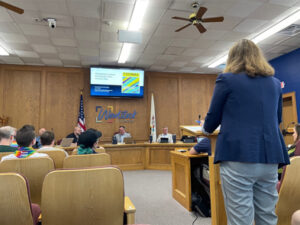
In addition to forming a task force, we surveyed residents and visitors, so everyone had a chance to participate. The formal Arts Commission for the City of Woodstock also guided us along the way and was our sounding board throughout the whole process. We met regularly with them, provided interim reports and made modifications as we went. They, along with city staff, were the liaison to the Mayor and City Council.
We also did a lot of interviews, both with local folks and other communities who have a focus on the arts. Rachel did many of the interviews.
Rachel
Yes – I reached out to several different communities that have a focus on the arts. I spoke with different people, often city staff who are in an arts role, or folks in the local visitors bureau, or leaders of local arts organizations such as galleries or theatres.
The city of Elgin, for example, has a large section of their city staff dedicated to the arts. I also contacted folks in Eau Claire, Wisconsin, where their arts focus is administered outside of the city government, within the Visitors Bureau.
In the process of interviewing all these folks, we looked at different ways that communities integrate the arts. We found a wide variety of approaches, and it became clear to us that there are many different paths to integrating the arts successfully into a community. What’s most important is to have a path and at least one person whose job is to focus entirely on the arts, whether that person is in local government, a visitors bureau or a nonprofit organization.
One of our goals was to show Woodstock many examples of communities that have integrated the arts successfully so they could make an informed decision about the best approach to fit their community.
 Mim
Mim
In a project like this, you never know at the beginning which way the community will go and what will be the right fit. It’s important for us to start with a broad approach and to bring together as many community members as possible. We kept an open mind and played a coordinating role to help the city determine their vision and priorities, and I think that’s one of the strengths of CGS.
Paula
Rachel is a graduate assistant with CGS, and urban planning is new to her. She just finished law school, and she did an amazing job adapting to not only planning, but also learning about the arts, which is a new area for CGS. CGS works with several graduate assistants each year, and that helps us build out our project teams and gives them great work experience.
Rachel
A unique thing about NIU law school is that law students can have graduate assistantships, and the tuition waivers that come with those, which is very uncommon among law schools. I happened upon the role in CGS because Mim had done a plan in the town where I live, the Village of Hinckley. We connected because I was doing some work with the village. We had a conversation, and the rest is history!
While I was working at CGS I discovered I have a love of local government planning, so I’m planning to stay in local government consulting after law school.
It’s interesting that you go into the planning process with an open mind instead of a set direction. Was there anything that surprised you or went in a direction you could not have anticipated?
Mim
I learned one thing that I didn’t anticipate at all. When I came into this process, I assumed that many communities would be competing with each other in terms of arts reputation and facilities. But what I learned in talking with many of the facilities managers such as the Woodstock Opera House, the Egyptian Theatre here in DeKalb and other performance spaces in the region, is that it doesn’t work that way. Instead of directly competing with one another, the performance venues have each developed their own niche based on the number of seats they have, the audience size and the number of tickets they can sell. Those features attract different types of performers, so in general the theatres didn’t feel like they were directly competing with one another at all because they each had their niche audience. Once we learned that, it became part of our task to help Woodstock identify their niche and unique identity.
Rachel
For me, one of the surprising things about talking to the facilities managers was the fact that making money wasn’t their primary goal. Yes, they’d like to bring in enough money to operate smoothly, but these organizations view themselves as a community asset, and their primary mission is to serve the community, the local schools, folks who want to host community events. Most of these theatres are nonprofits or, in the case of Woodstock, owned and operated by the city government. So these are not just performance venues, but community assets that are really valued as a part of the community.
Mim
Another thing that was very interesting was the way the different theaters and performance venues are operated. The Woodstock Opera House is city owned, while many others are independent, which makes a huge difference in terms of how they’re financed, and also how the venue makes choices about the art they’ll make available. An independent theatre can afford to be more experimental or take more risks than a city government that answers to the city council and, ultimately the citizens. On the other hand, an independent theatre doesn’t have the stability of tax-based funding and is more reliant on selling tickets to operate.
Paula
It’s very unusual to have an Opera House that is city-owned and city-operated, so I think that’s part of the reason CGS was such a good fit for this project. Our team was very adaptable and was able to apply our understanding of local government to this different context for arts and performance venues. Because of the open-minded way we approach each project, everything about this plan is unique to Woodstock – from the organizational structure to the funding and implementation recommendations.
Mim
True. Of the many, many arts and culture master plans we read from across the country, I don’t recall another one that was like ours, but I we felt like this plan was the best fit for Woodstock, and it was well received by the city.
You’ve said Woodstock is ahead of the curve in planning for arts and culture. Why is it important for other communities to plan for the arts, too?
 Mim
Mim
Most communities aren’t planning for the arts, but they are pursuing arts to some degree because there’s wide recognition that the arts have become a catalytic tool for revitalizing a downtown, revitalizing neighborhoods, changing the image of a community, bringing in jobs and strengthening businesses.
The arts touch so much of a community that they’re very attractive as a tool for growth of all sorts. But growth of the arts is happening piecemeal in most places, with no cohesive, comprehensive plan. By failing to plan more comprehensively, I think communities are losing so much opportunity to maximize the benefits of the arts.
Rachel
Yes! I was just putting together a session about placemaking at the Illinois City and County Management Association conference, which is happening right now. Placemaking is all about harnessing the power of arts and culture to transform spaces into sites of vibrant and inclusive community, and it’s really important for communities right now.
What would you like folks to know about the unique features of the Woodstock Arts and Culture Master Plan?
Paula
To me, what’s most unique is its flexibility. Most plans are very straightforward: do A, then B, then C. Ours is not like that. Instead, we provided a lot of options, so the city can use the plan going forward even as priorities change.
Mim
I think Paula is absolutely right. We presented the plan to the City of Woodstock, and the mayor said in the meeting: “This is not a plan to sit on a shelf.” We truly designed it to be a facilitation tool so the community can use the process outlined in the plan to arrive at the optimal decision, no matter what choices are put in front of them.
Paula
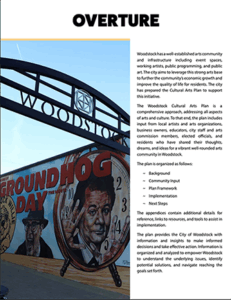
The plan is nearly 200 pages long, and about half of that is the plan itself and half is appendices with data and supporting documents. The background information and examples will help the city take the next step to turn their decision into concrete action.
Mim
Even the design of the document itself is unique to Woodstock. The table of contents is designed like a playbill to emphasize Woodstock’s connection to the performing arts – Rachel and Paula came up with the design! The plan is modular, so it can be pulled apart. You can hand ten pages to somebody who’s going to be doing one particular thing, and they’ll have a mini handbook for that thing, rather than an intimidating 200-page document.
This idea that the municipalities aren’t directly competing, but each have their own niche is interesting. What is Woodstock’s niche?
Paula
I think their niche is a home-grown arts community – a grassroots effort. A lot of artists live locally, and I feel like they were a driving force behind this plan and even the formation of the Arts Commission. They want to turn the community into an arts destination, to make it known and branded as an arts community, not just locally but throughout the region and state.
Mim
I would add that the physical characteristics of Woodstock are unique and make it a special place for the arts. It’s a historic community of about 25,000 people, all built around a town square which already hosts events. Their architecture is well-preserved and lovely. When someone goes to an exhibit or performance in Woodstock, they’re not just experiencing the theatre itself. Woodstock is very walkable, and the area is so attractive that you can go to dinner, browse the shops and enjoy the ambiance the downtown presents.
Rachel
“Arts and culture” means a lot of different things. It means visual and performing arts, but also the people and environment. The place itself can be part of the arts experience.
Mim
Another hallmark of a CGS project is that we can assemble a great team to serve whatever the community is and whatever they need. The researchers and planners at NIU CGS are not all the same. We have different backgrounds, and we all bring unique ideas and work well together. I think the client benefits from that with a product that’s special and tailored.
Rachel
Yes. The collaboration throughout this entire process, not only with the community, but in our team meetings, was creative and productive, which ended up in a special and unique plan.
