Part two: an interview with NIU graduate student Emelia Essumanba-Josiah.
Community engagement is central to NIU’s mission as a regional public university. An NIU faculty member is leading a study to find out what factors influence faculty participation in community-engaged research, teaching and artistry. We spoke with Assistant Professor Alexios Rosario-Moore, Ph.D., and graduate student Emelia Essumanba-Josiah to learn more about the study, why community engagement is important, and how Emelia is learning about the research process as a graduate student.
You can read our interview with Alexios in part one of this blog series. Here’s our interview with Emelia.
Hi Emelia! Can you start out by sharing, how did you get involved in this research project, and what was your role?
I worked in the NIU Division of Outreach, Engagement and Regional Development as a Graduate Research Assistant, and one day my supervisor asked if I was interested in assisting a professor who was working on a research project – he could use some extra hands.
Because I am looking for opportunities to learn and be better, I was excited and said yes! Professor Alexios Rosario-Moore was working on a multi-year research study on community engagement work titled “Examining Faculty Participation in Community-Engaged Scholarship and Artistry at a Public R2 University.” I joined his research team, and my role was to help analyze the data collected. Months after, as the project progressed, Alexios confirmed I could be a co-author, and I was very happy about the opportunity.
What did you learn from participating in the project?
I love learning about models. So, one of the things that stood out to me was the models used in this project, including the Faculty Engagement Model (Wade & Demb, 2012) and Biglan disciplinary coding (Dobernick & Schweitzer, 2017). It was also my first professional experience working with mixed research methods.
My favorite finding was the fact that the study confirmed academic appointments in universities were a factor that increases the likelihood of participation in community- engaged scholarship and artistry at a public R2 university. This actually made sense, as a promotion of this kind makes you develop a deep sense of commitment to the institution and its social impact projects.
What was the experience of the MWERA conference like?
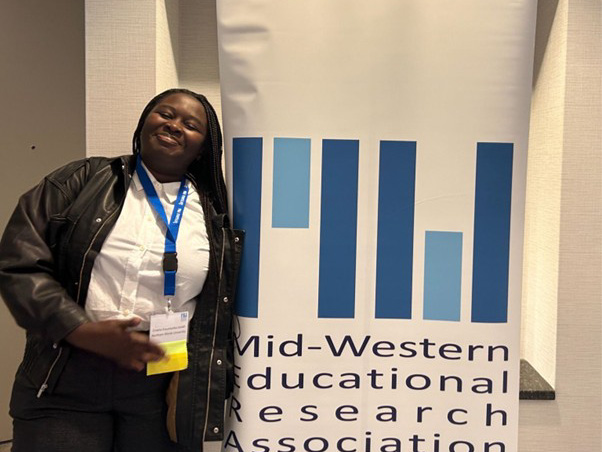
I’m an international student from Ghana. This was my first academic conference in the USA, and it will never be lost on me. Not now, not in ten years. Every graduate student dreams about going to conferences and giving paper presentations. Especially as an international student, you will always want to have that experience here in the USA. So, when we were selected for the conference presentation, I was very happy. My experience in Wisconsin was great. I joined different sessions at the conference and learnt a lot of things I now apply in my presentations. Professor Rosario-Moore asked me to prepare for the presentation and I did. I presented the first/introductory parts, and it was a good experience.
Why was it important to you — at this point in your education/career to be able to give a joint presentation with a faculty member?
I have been working hard on my term papers, and preparing to be able to submit them for conference papers, etc. It sometimes takes time. So, getting this opportunity at the time I did helped. It boosted my confidence and added to my CV and LinkedIn updates, which helps especially as I am looking for post study options now (jobs and higher education offers).
Is there anything else you’d like to share?
It is interesting that I am a graduate student in the Communications department but got to work with a faculty member in the College of Education. Everyone wonders how that happened when I speak about it! For me, it reminds me that I am very determined and, whatever I set out to do, I give it my best. It also highlights the power of collaboration in the sense that Professor Rosario-Moore took a chance by getting me on board regardless of my course direction, and it all worked out perfectly. I am very grateful for his guidance and mentorship.
About Emelia Essumanba-Josiah
Emelia Essumanba-Josiah is a graduate student earning her master’s degree in the NIU Department of Communication. She is an international student from Ghana with a research focus on health communication, culture and technology. She is interested in how culturally responsive design content and co-created digital communication strategies influence health behaviors, technology adoption and policy attitudes among marginalized and immigrant populations.
