
Part one: an interview with Assistant Professor Alexios Rosario-Moore, Ph.D.
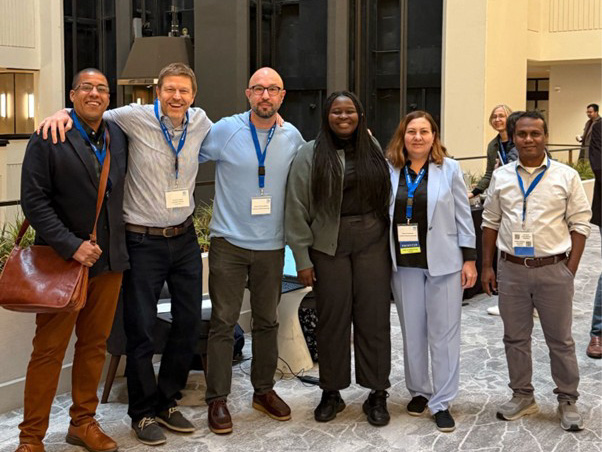
Alexios (third from left) and Emelia (fourth from left) presented at the Mid-Western Educational Research Association Conference in late 2025.
Community engagement is central to NIU’s mission as a regional public university. An NIU faculty member is leading a study to find out what factors influence faculty participation in community-engaged research, teaching and artistry. We spoke with Assistant Professor Alexios Rosario-Moore, Ph.D., and graduate student Emelia Essumanba-Josiah to learn more about the study, why community engagement is important, and how Emelia is learning about the research process as a graduate student.
First, our conversation with Alexios. You can read our conversation with Emelia in Part two of this blog series
You presented “Examining Faculty Participation in Community-Engaged Scholarship and Artistry at a Public R2 University” in late 2025 at the Mid-Western Educational Research Association Conference. Can you start out by sharing a little bit about the research – how did you begin this study, and what is important about it?
I connected with the NIU Division of Outreach, Engagement and Regional Development shortly after arriving at NIU because one thread of my research is related to university-community engagement. I’ve been looking at collaboration between universities and external partners, but my connection with the NIU Engagement Roundtable prompted me to study what was going on within NIU in terms of faculty members participating in community-engaged scholarship and artistry.
This particular paper addresses, what kind of internal and external factors shape the decision for faculty members to participate in community-engaged scholarship? Is it influenced by their background characteristics? Their ethno-racial identity, their gender identity, where they’re from? Or is it shaped by their discipline and the perception of their discipline towards what constitutes knowledge? This part of the study asked, what personal, professional, disciplinary and institutional factors influence faculty participation in community engaged scholarship and artistry?
How did you design and conduct the study to answer those questions?
It’s a mixed method study. We designed a questionnaire that used constructs and scales from prior research to get into those questions. Then we did follow up interviews to look at how faculty members describe influences on their community-engaged scholarship and artistry, and how they think about their own identity, their work, and how they navigate institutional challenges and institutional support. We fielded the questionnaire to all the full-time faculty members here and got a pretty good response rate of 31 percent, which is 204 responses.
We ran a set of regression analyses to examine, what were the correlations between personal, professional and disciplinary characteristics and the person’s stated participation in community-engaged scholarship and artistry? One caveat is, unfortunately, a high proportion of the faculty respondents didn’t feel comfortable entering their demographic information, so we didn’t have the power to test those relationships. But we did find that professional dimensions are predictors of participation in community-engaged scholarship and artistry.
Disciplinary position, in particular, had a high significance, suggesting a stronger disciplinary position towards community engaged scholarship is associated with a greater likelihood of participation. There are some disciplines where the view of engaged scholarship is contested. Faculty are thinking, what are the different viewpoints within my department? Are there more traditional scholars who want to see a certain kind of research output in particular journals? What are professional associations signaling to me? If I go to a major conference in my field, do I see other engaged scholarship represented?
It sounds like academic discipline is a huge factor impacting faculty community engagement. What other influences did you find?
There’s also the role of grants. At least under the prior administration, there were federal agencies that encouraged or even required a community-engaged component, whether that’s reporting findings to the community or engaging with community members during the study design process.
The other thing that came out of the interviews but not the quantitative data was that certain faculty perceived that their background, upbringing, mentoring, and in some cases their ethno-racial or gender identity influence how they think about themselves as scholars and how they choose to engage with engage with communities.
Each scholar is an individual, and their motivations are unique, but some common themes emerged. Coming from the interviews and open-ended survey responses, some folks in the arts identified particular challenges. Some art forms like theater are perceived within the field as fundamentally engaged. Even though some theater artists who do community-based theater might contest that statement and argue that truly engaged theater generates the production in concert with the community, many within theatre see all performances as community engaged. Visual artists, on the other hand, whose work is tracked and measured by participation in juried art shows, have other challenges of not getting credited for community-engaged projects.
Are there any other important findings you’d like to share?
Another important finding is that there is a shared perception that at NIU the leadership supports community-engaged scholarship and artistry, and that some of the challenges are productive challenges, like trying to make meaning collectively at the department level and to understand one another’s work and get some credit and acknowledgement for it.
What are your next steps moving forward?
We’re going to run the survey again in the fall of 2026 to see if there’s been any change. Because the larger question here is, how has community engaged scholarship and artistry been institutionalized through some of the structural efforts NIU has been working on? I’m very curious to find that out, and I definitely encourage any faculty members reading this to participate and to know I’m making all efforts to remove any identifying data and protect privacy.
What are some of the benefits of community-engaged scholarship and artistry?
Community engagement is reciprocal, and there’s a knowledge exchange. If you’re studying a phenomenon in the community, it’s likely that community members are going to be experts on that phenomenon. I think just having those relationships is also beneficial. A lot of community-engaged scholars and artists have a greater disposition towards being in the field, being around other people, learning from them and forming those social relationships, which are powerful in and of themselves.
There’s also an altruistic motivation. Many scholars we interviewed learned from their families and mentors about the importance of contributing to society. Many scholars see a challenge in their communities, and they want to make a difference to address that challenge.
What is the benefit of doing this research to find out about professors’ influences, motivations and experiences with community engaged artistry and scholarship?
The research is important because it can inform how NIU and other universities further support community engaged scholarship and artistry. There are a lot of universities, including NIU, that want to make a difference and work closely with the community. Understanding who the faculty members are who commit to community-engaged work and why they do the work will help universities design programs and structures to support community engagement. This project also contributes to research that might positively influence some of the disciplines that don’t typically perceive themselves as community engaged. It gives a scholarly foundation to faculty who want to advocate for community-engaged work within their departments or disciplines.
**
Alexios recently presented about this research along with coauthor and NIU graduate student Emelia Essumanba-Josiah at the Midwestern Educational Research Association (MWERA) Conference in Milwaukee.
Read Part two in this blog series to see our interview with Emelia.
About Alexios Rosario-Moore
Alexios Rosario-Moore is an assistant professor in the Department of Leadership, Educational Psychology and Foundations, in the NIU College of Education. Alexios is a multi-disciplinary scholar focused on university-community engagement, graduate student socialization and civil rights in schools. With over twenty-five years of experience in public education—as a teacher, non-profit leader, and program evaluator, he brings a rich understanding of the relationship between educational research and practice.
Learn more about Alexios Rosario-Moore.
