
Since 2018, NIU Sociology Professor Keri Burchfield has been publishing work on the nature and scope of crimes against animals, and correlations among crimes against animals and humans. She has worked to solve community problems collaboratively through the Safe Humane Lifetime Bonds Program, which pairs shelter dogs with youth who are incarcerated for a training program that benefits both the humans and dogs. In 2020, she was the recipient of NIU’s Presidential Engagement and Partnership Professorship, which acknowledged the reciprocal partnership she developed with the Illinois Youth Center, Aurora Animal Control, and Kane County Jail to match at-risk shelter dogs with incarcerated youth. Recently, the program has expanded into DeKalb County.
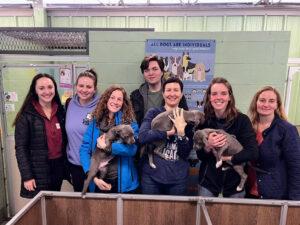
Burchfield, who teaches in NIU’s Department of Criminology and Sociology, conducts interdisciplinary research on the connections between animal welfare and human crimes. She characterizes her work as an equal amalgamation of academics, advocacy and activism.
As a community-engaged project, Lifetime Bonds ventures beyond scholarship with practical partnerships and civic support. Illinois Youth Services in Chicago and St. Charles, the YMCA of Metropolitan Chicago and DeKalb High School are among program collaborators. Participating regional shelters include the Animal Care League in Oak Park, Chicago Animal Care and Control,
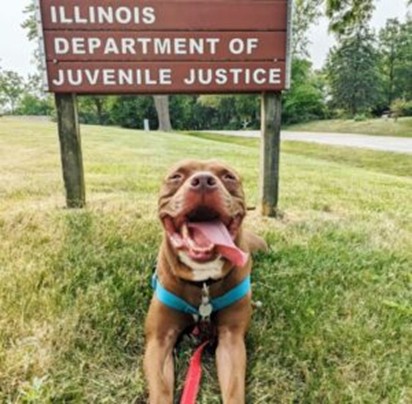
The rusty brown “pit-bull” mix learned avidly alongside his teenaged handlers in Lifetime Bonds courses, which empower young people who have committed criminal offenses by enlisting them to train shelter dogs for adoption. Hundreds of thousands of dogs like Riley are euthanized each year at over-capacity animal shelters, according to the American Society for the Prevention of Cruelty to Animals (ASPCA).alb County.
Naperville Area Humane Society, and Tails Humane Society in DeKalb.
“Some of these animals never make it out of the shelter, and you feel like you’re literally working to save lives,” Burchfield said. “I knew Riley for almost three years before he was euthanized because, sadly, no one came to adopt him. Having that outcome makes you wonder: ‘What more can I do? How else can I reach people?’”
Looking at both ends of the leash
Burchfield has sought to answer these questions by pairing two often-stigmatized populations — troubled teens incarcerated by youth services and larger dogs abandoned at overcrowded shelters. Bigger breeds face disproportionately long stays relative to other adoptable animals.
The young people enrolling in Lifetime Bonds explore weekly topics with a curriculum tying canine behavior and training to broader themes of animal oppression and human connection. They journal in workbooks, create adoption flyers for their chosen dogs, and learn skills and tricks with these shelter pups to perform in a graduation show at the end of the 10-week program.
“The dogs are in jail just like us,” a participant observed.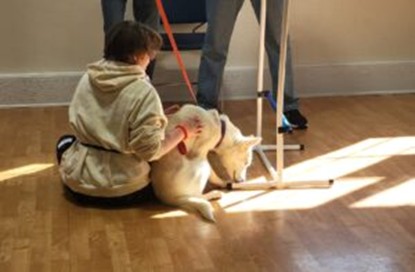
“We have a lot in common with the dogs,” someone else commented.
Beyond a hand from colleagues within sociology, Burchfield has reached across disciplines for her latest round of research. She worked with NIU College of Education Professor Zachary Wahl-Alexander to develop a schema for coding interactions between program participants and the dogs being trained — a Systematic Observation of Human-Dog Activity (SOHDA). Several NIU graduates and undergraduates have assisted with collecting data from courses.
Read more about the community-engaged partnership in NIU Today.
