
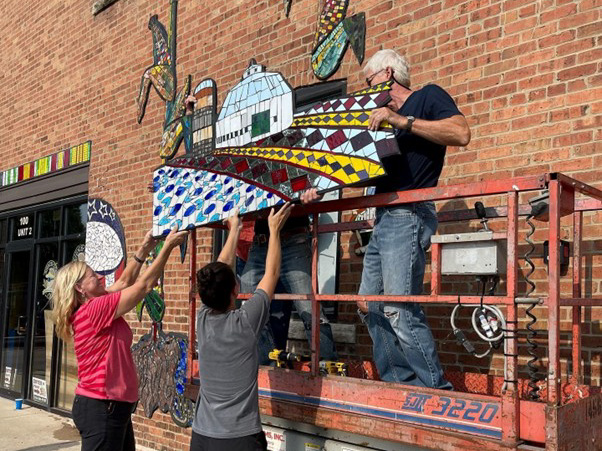
The community-supported downtown Hinckley mural is one example of benefits inspired by the DCCF grant program. The artist collaborated closely with community members.
A Collaboration Between the NIU Center for Governmental Studies and the DeKalb County Community Foundation Continues to Make a Positive Difference Ten Years Later
Ten years ago, the DeKalb County Community Foundation (DCCF) had a radical idea to promote community development across the county’s rural, suburban and urban areas. They offered $20,000 for each municipal government within the county to engage in an in-depth strategic or economic planning process. Each community was given another $20,000 to enact one or more of the priorities identified through their planning process.
This fall, the foundation asked NIU’s Center for Governmental Studies (CGS) in the Division of Outreach, Engagement and Regional Development to conduct a follow-up study to find out how each community used their funding, learn about the successes and challenges of the planning and implementation processes, and determine what next steps would keep the momentum rolling on county-wide community development. The study highlights the impacts made by the DeKalb County Community Foundation’s $600,000 investment in our local county and community.
Jolene Willis, grants and community initiatives director for the DeKalb County Community Foundation, says, “Investing in the capacity of our communities, and helping them plan for a strong future, is at the heart of our mission at the DeKalb County Community Foundation. More than a decade ago, our Board of Directors believed that offering every local government the tools and resources for thoughtful planning could spark long-term, county-wide progress. Today, we see that belief affirmed. Each community, from our smallest villages to our largest city, has taken this opportunity to chart its own path and strengthen quality of life for its residents. We’re proud to continue supporting this work and to partner with organizations like NIU’s Center for Governmental Studies to ensure that momentum, collaboration and community-driven vision remain guiding forces for DeKalb County’s future.”
Planning Process Benefits Are Seen Across All Communities
In the decade since DCCF made this funding available, each of the county’s 14 municipalities, as well as the DeKalb County Government, accepted both sets of funding and engaged in planning processes. Communities ranged from the Village of Lee, with 308 residents, to the City of DeKalb, with just over 40,000. Each community chose a planning focus and follow-up projects designed for their specific needs. Every one of these local communities chose to work with the NIU Center for Governmental Studies for at least one step in their community planning process. Often, this involved preparing a comprehensive plan or community development strategy.
CGS Senior Research Associate Mim Evans notes that the communities all reaped benefits from the planning process itself, which helped to build relationships and empower residents in ways that still make a difference.
“Each community went through the planning process, which involved gathering a group of residents on a regular basis and getting feedback from business leaders, elected leaders and other stakeholders in the community,” says Evans. “That process was truly valuable to the communities because it empowered residents and was a tremendous educational opportunity for them to learn how local government works and how they have agency to create the community where they want to live. It was a great awakening within many of these communities of active, dedicated residents who moved into leadership roles. The communities continue to benefit many years later.”
Tailor-made Plans Were Put into Action
While the planning process shared similarities across all communities, each community’s plan was tailored to their size, location and goals. Some communities focused on strategic planning and defining their long-term vision. Others focused specifically on economic development, land use planning or bringing in more tourism. Evans says, “This grant program was unusually flexible, allowing each municipality to decide what kind of plan would be most useful to them.”
Thanks in part to additional funds from the DeKalb County Community Foundation, each community was able to put at least part of their plan into action. Some of the projects were funded through DCCF grants and some were funded in other ways, including other grants, local fundraising and private sector investment. All were inspired by the DCCF-supported planning process and the plans it produced.
These are just a few of the projects each community has engaged in:
- Cortland focused on quality-of-life improvements, including roads, sidewalks, playground equipment and a paved connecting pathway. New housing has been built with more under construction, and an updated land use plan was completed to guide further growth.
- In DeKalb, a transit guide was prepared to help residents and area employees find affordable and convenient public transportation. Funding was provided to an entrepreneurship program to help start new local businesses.
- Genoa installed a canoe launch on the Kishwaukee River for resident quality of life and to attract tourists.
- Hinckley funded an intern position to help grow local businesses, improve communication with residents and update the village website. New homes have been built, and more are under construction. A downtown building is being renovated to become the new home of the public library, and a large downtown mural project was completed.
- A Kingston collaboration with the Forest Preserve District has improved outdoor recreation, and progress has been made on the Genoa-Kingston Trail.
- In Kirkland, a parking lot has been converted into event space with a farmers’ market, and new business has developed downtown.
- Lee has beautified the downtown with a gazebo and planters. They’ve received additional funding for outdoor recreation facilities and their first municipal water tower, and they’ve improved resident communication and involvement.
- Malta built a new bike path connecting an outlying subdivision to the rest of the community and instituted a new fall festival and concerts in the park.
- Maple Park focused on a strategic plan and used the implementation grant to build a new playground. They’ve also worked on façade grants for downtown buildings, ongoing street paving, new home construction and updated storm water management.
- Sandwich beautified the community with new banners. They also added a website and staff position, and home construction has been taking place.
- Shabbona conducted a community survey that identified park improvements as a priority. The community is working on a match for their outdoor recreation grant.
- In Somonauk, new planters and banners help to beautiful the town, which has also completed a dog park and pickleball courts. A Christmas Walk event brings the community together.
- Sycamore completed an updated land use plan and industrial market study. A new fire station is under construction, as is new home construction. Water improvements and better collaboration between taxing bodies are in the works.
- Waterman conducted a community strategic plan and a new comprehensive plan. Their improvements in the last decade have focused on water planning to allow for further growth, home construction and a new dog park.
Next Steps for County-wide Development
The CGS review found that momentum remains strong for community development within DeKalb County. There are several transportation corridors throughout the county with development opportunities, while parks and forest preserves offer tourism opportunities to some communities. Many communities continue to rebuild downtown businesses and create public art, and several are turning their attention to accessible housing for aging adults.
“People are DeKalb County’s greatest asset, and our rural communities are full of promise and potential,” says Willis. “Economic mobility is essential to long-term success, and through the new rural vitality initiative led by the DeKalb County Economic Development Corporation and a committee of countywide partners, we’re identifying the next steps to strengthen rural places by equipping local champions and advancing community-driven plans.”
Learn more about the DeKalb County Community Foundation at dekalbccf.org. Learn more about the NIU Center for Governmental Studies at cgs.niu.edu.
